



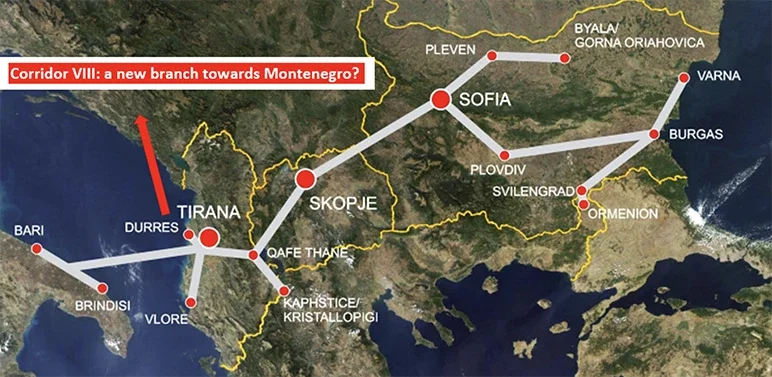
Expanding the scope of Corridor VIII with a lateral branch connecting Durrës to Podgorica, thus extending the Corridor to Montenegro. This is the innovative proposal that Albanian, Montenegrin, and Italian experts are converging on during meetings held in 2025 as part of the strategic project Interreg IPA South Adriatic Connectivity, which encompasses various objectives along the Italy-Montenegro-Albania axis to improve Puglia's connectivity with Montenegro and Albania.
The meetings led to the shared definition of the Corridor VIII report index, which will be published by 2026, including the Montenegro branch.
The project's many activities include an in-depth analysis of the status of Corridor VIII - one of the objectives identified by the Asset agency - a long-planned transport corridor, originally conceived to connect the Adriatic Sea with the Black Sea, stretching from Albania through North Macedonia to Bulgaria.
The idea originated in the 1990s, after the Cold War, as part of European efforts to reconnect and stabilize the Balkans by improving east-west connections. While north-south routes were better developed, east-west infrastructure was lagging, limiting trade and regional integration.
Corridor VIII aims to build and modernize roads, railways, ports, and airports, connecting ports such as Durrës (Albania) and Varna/Burgas (Bulgaria). Despite strong political support, progress has been slow and uneven, due to financing difficulties, difficult terrain, and regional coordination issues.
Today, Corridor VIII remains a strategic symbol of European integration in Southeastern Europe; partially completed, it still represents the goal of economic development, connectivity, and cooperation in the Balkans.
Connectivity is led by the Puglia Region – Mobility Infrastructure Section, with partners including the Asset agency, the Southern Adriatic Sea Port System Authority, and the Molise Region; for Albania, the Ministry of Infrastructure and Energy, together with the Port of Durrës; for Montenegro, the Ministry of Maritime Affairs, together with the Port of Bar; and an associated partner, the Italian Ministry of Infrastructure and Transport.