


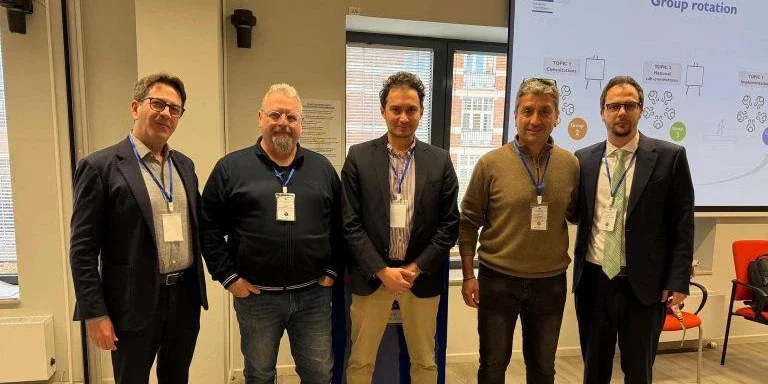
On 4 February, a seminar on the Partnership Principle in EU candidate countries was held in Brussels, organized by the European Commission, Directorate General for Regional and Urban Policy. The event brought together representatives of Interreg programmes, national authorities, and stakeholders involved in EU cohesion policy and enlargement. The seminar opened with welcome remarks by Moray Gilland, Head of Unit at the European Commission DG REGIO, who highlighted the importance of strengthening the Partnership Principle in EU enlargement countries. Claudio Polignano, Head of Managing Authority of Interreg IPA South Adriatic (Puglia Region) took part as speaker in the session related to the "Good practices in the design and implementation of Interreg programmes", sharing the Programme experience together with Emilia Cebotari, Head of the External Assistance and European Funds Coordination Department at the State Chancellery of the Republic of Moldova, Andrea Zlatkovska, Coordinator for Strategic Planning Regional Development at the Centre for Development of the East Planning Region (North Macedonia) and the MA Interreg NEXT Poland-Ukraine 2021-2027. Participants deepened their understanding of the Partnership Principle and its relevance for Chapter 22 accession negotiations, which focus on Regional Policy and the coordination of structural instruments. During plenary and interactive sessions, they exchanged experiences on stakeholder involvement, consultation mechanisms, and governance structures.
The discussions were supported by findings from a study prepared by the consortium t33, Naxta, and ÖIR for DG REGIO, which analysed the implementation of the Partnership Principle across nine candidate countries and twelve Interreg programmes in the 2021–2027 period. The research showed solid formal compliance with EU rules but uneven practical implementation, with cross-border programmes demonstrating broader stakeholder participation than transnational ones.
The seminar concluded by reaffirming the importance of inclusive governance and stronger stakeholder engagement in EU enlargement countries.